
Intelligence for agencies
Atria
Atria cross-references everything the agency knows on a live map, shows each analyst what matters and answers citing the source of every sentence. It is built from modules and runs on the agency's premises, with no connection to Harpe: a Spanish and European product.
- On the agency's premises
- No connection to Harpe
- Built from modules
- Classification markings
- Spanish and European
Capabilities
Eight capabilities on the same data
All eight share the data, the access policy and the log.
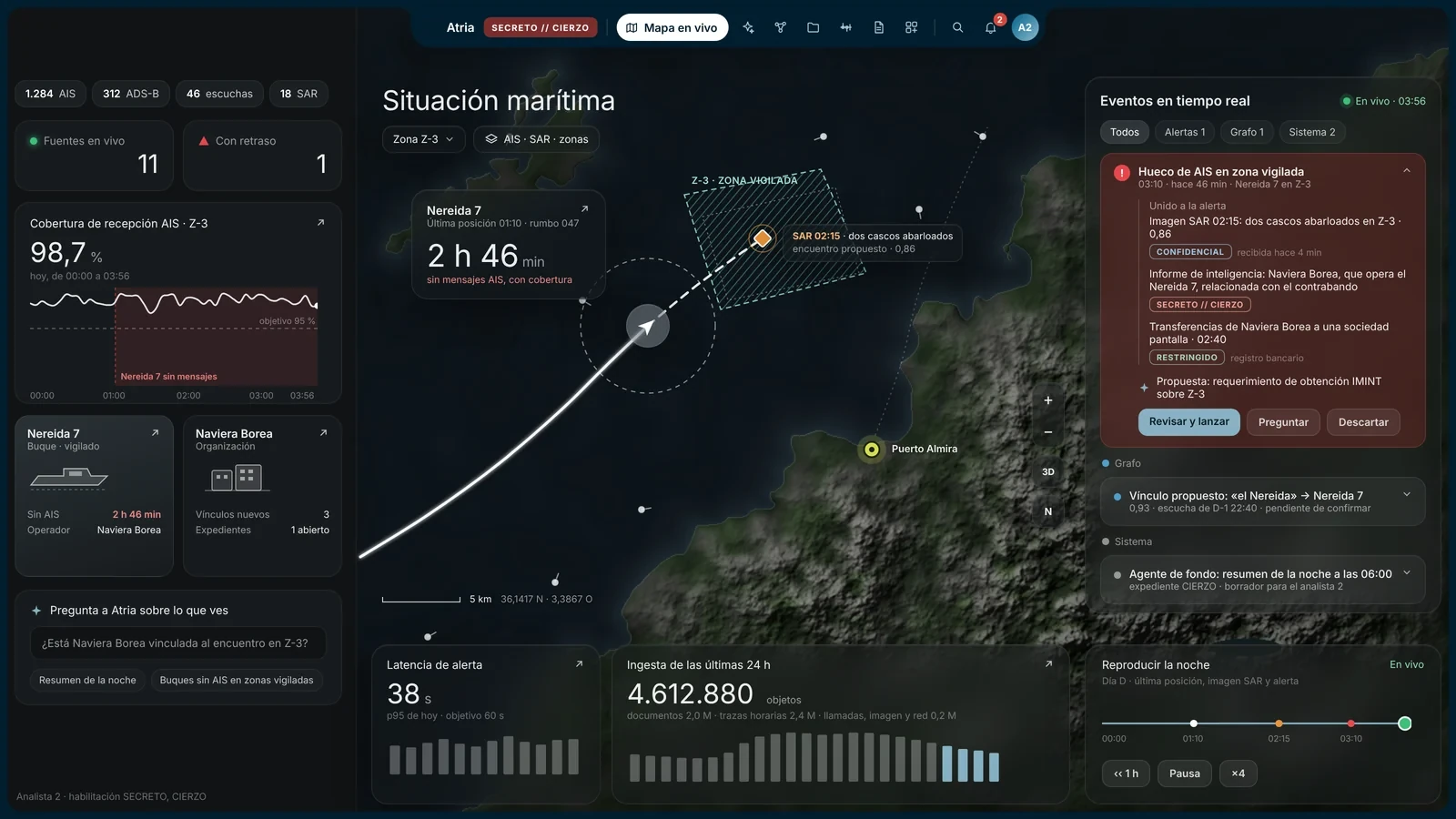
Live map
The situation on the map in real time, with its evidence.
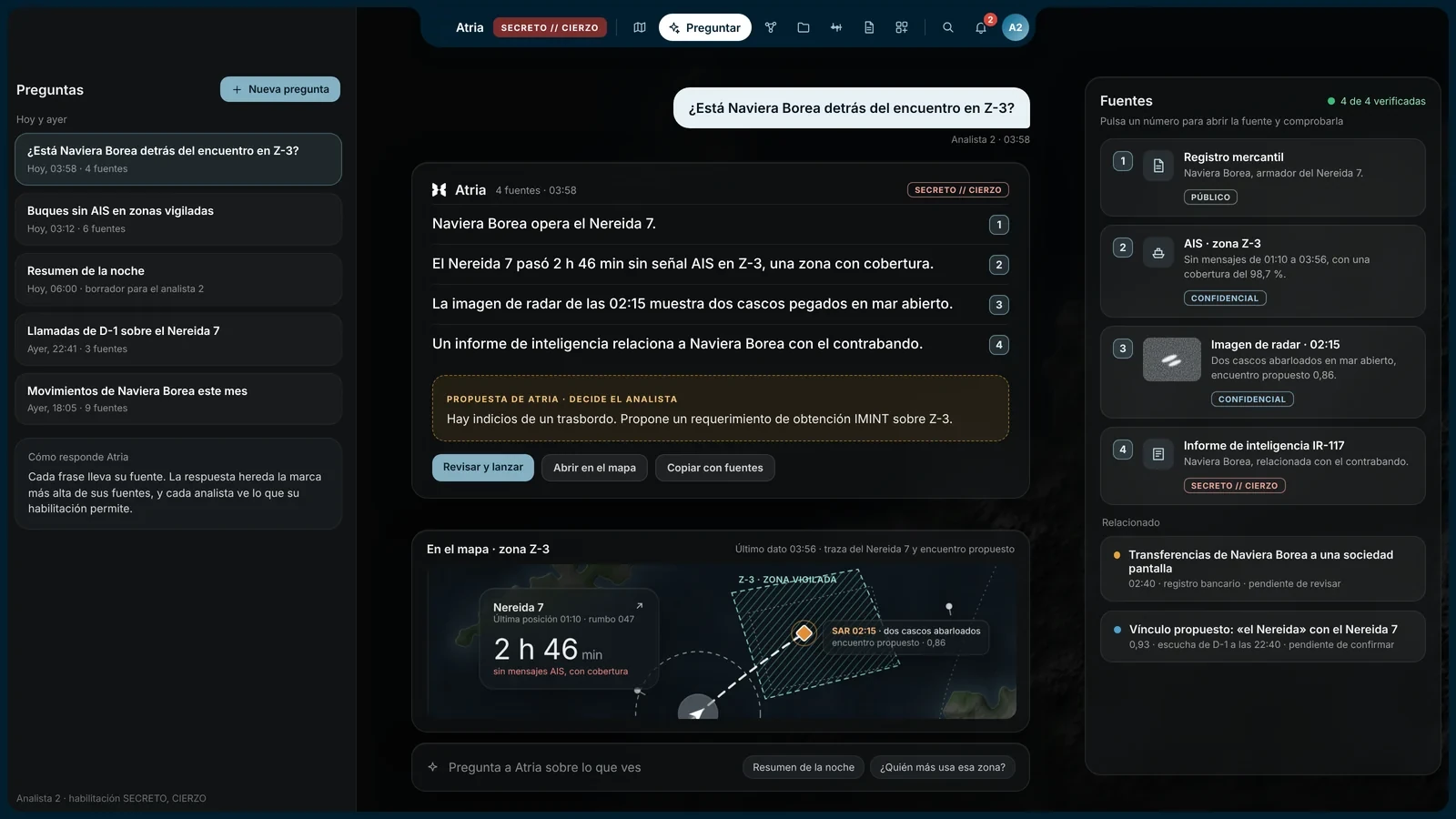
Questions with citations
Answers in natural language; every sentence comes with its verified source.
Multilingual search
A question in Spanish finds documents in Arabic or Russian.
Graph and links
People, organisations, vessels, lines and accounts, with the history of each relationship.
Decides what matters
It weighs every fact against each analyst's mission and flags what changes something, with the reason.
Scenarios
Alternative hypotheses, each with its probability and its assumptions in view.
Reports
Drafts in the agency's template, with citations and marking.
Actions
Requests, dissemination and surveillance, approved by a person.
Modules
Each organisation turns on what it uses
Atria is a common core and its modules, such as Atria Vision, Atria Eco and Atria Edge. Each organisation adds the ones it uses with the licence; a module that is not turned on is not installed and does not appear on screen.
Core
Data, classification, graph, cited answers and the judgement of what matters. Part of every installation.
Open sources
Reports, media and social networks in every language, with translation and summaries.
Atria Vision
Geospatial vision: live map, vessel and aircraft tracks, zones, and satellite, aircraft, radar and drone imagery, with Harpe's vision models.
Signals and voice
Lawful intercepts, transcription and translation.
Cyber
Logs, traffic and indicators, with Atalaya's events.
Command and operations
Operational picture, planning, orders and reports.
Atria Eco
Real-time assistant for defence, security and emergencies, in the helmet, the vehicle or the command post.
Atria Edge
Harpe's vision and coordination models on board the drone, with or without a link.
Builder
Dashboards, functions and automations the organisation builds with its own team.


Sources
Every sentence from Atria carries its source
- It answers in natural language to the analyst's question.
- Every sentence with its source: register, position signal, image or report.
- The analyst opens the source and checks it before deciding.
Data
Atria reads eight types of agency data
Every source comes in with its legal basis: regime, purpose, retention and use.
Reports and text
Human sources, documents, press and open sources.
Intercepts
Voice, messages and metadata intercepted under judicial authorisation.
Audio
Ambient recordings and audio from video.
Imagery
Optical satellite and SAR radar, drone and photography.
Video
Drone, cameras and open-source video.
Geospatial and tracks
Vessels, aircraft, GPS and moving targets.
Registers
Transactions, company registers, border crossings and telecommunications.
Networks and cyber
Network flows, DNS, system logs and indicators.
Automations
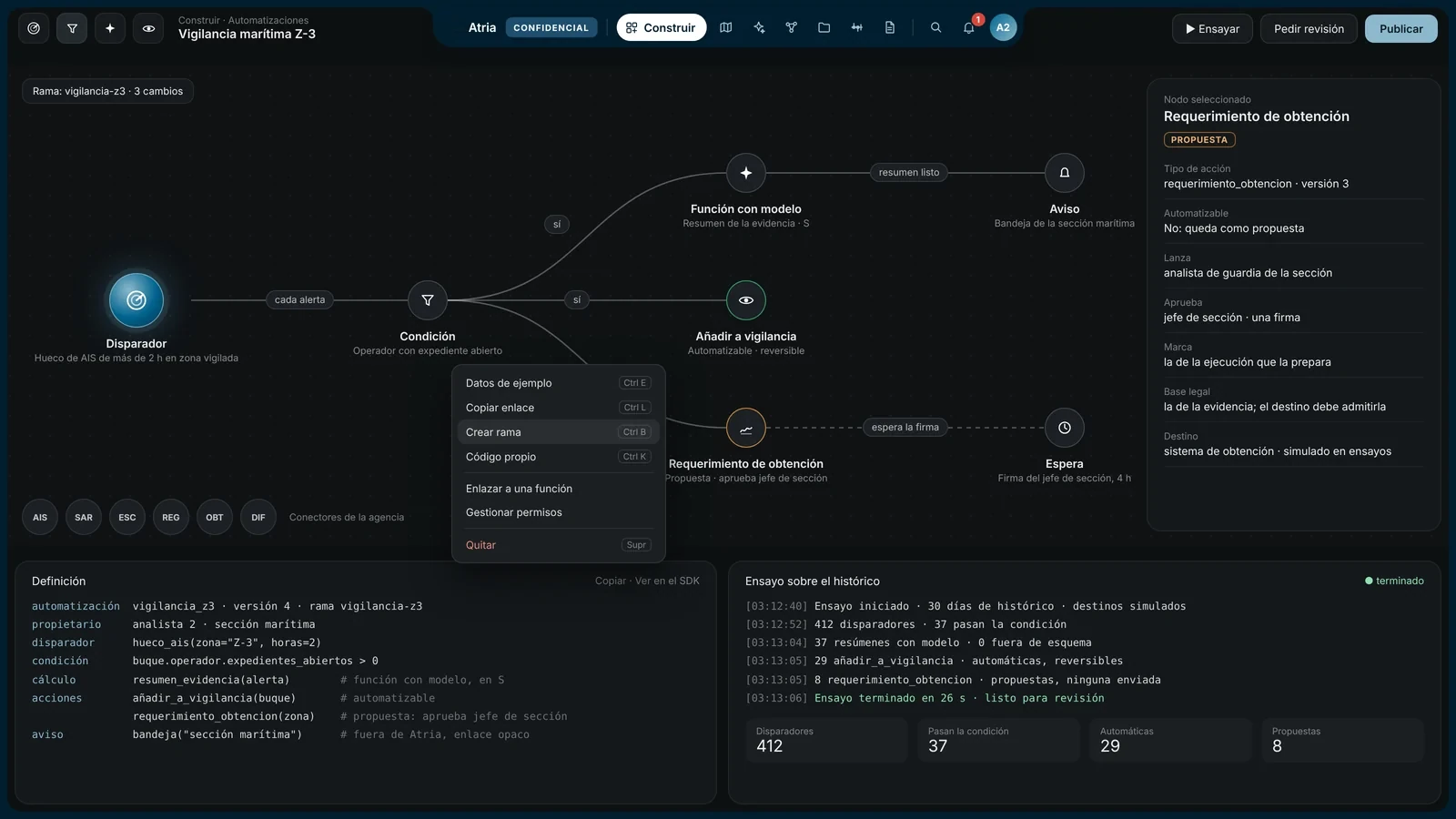
The agency builds its automations without depending on Harpe
- No-code blocks: trigger, condition, action and alert.
- A 30-day trial run on historical data before activation.
- A second person reviews every automation before it is published.
- A person signs off the actions that leave Atria.
Models
The client tunes the models on its network and keeps the weights
At Harpe
Pre-training
With public data and synthetic data from the world simulator. Harpe does not use its clients' data.
At the client
Tuning
With the agency's real data and its analysts' corrections, through fine-tuning and reinforcement learning.
At the client
Use and improvement
The analysts work with the tuned model, and Harpe sends signed versions without seeing the data.
The client keeps the tuned weights on its network, with the marking of the data that trained them.
Security
The agency controls who sees each piece of data
Principle
A person approves every action that leaves Atria for another system.
Atria proposes and the analyst decides. The platform records who approved what and when.
Classification markings
Every piece of data carries its marking, and everything derived from it inherits it.
Access before the model
The platform decides what each person may see before it queries the model.
Tamper-proof log
Every query and every action, with user and result.
Encrypted models
The agency's team decrypts them after verifying their boot.
Deployment
Atria runs on the agency's premises
The agency runs Atria with its own staff. Harpe delivers signed software and models, and receives no data, metrics or weights.
Deployment
- On the client's premises, with no connection to Harpe
- Off-the-shelf hardware in the client's server room
- Signed updates, with no service downtime
- Support without seeing the data
Interoperability
- NATO image, video and track formats
- NATO classification markings
- Military messaging and command and control
- API and SDK for the client's systems
Regulatory framework
- Spanish Official Secrets Act
- CCN certification and accreditation
- Data protection
- Regulation (EU) 2024/1689 and export control
Sovereign. Atria is a Spanish and European product. The agency installs it on its premises, keeps the weights it tunes with its data and can say that what it uses is sovereign.
Other products
Atalaya and Atria's modules
Next-generation cybersecurity
Protects computers, servers, cloud, identities and physical assets such as fleets and drones. It stops a new attack by what it does and prevents data leaks.
For: Banks, hospitals, ministries, police forces and companies
< 1 % CPU at idle, targetAtria module
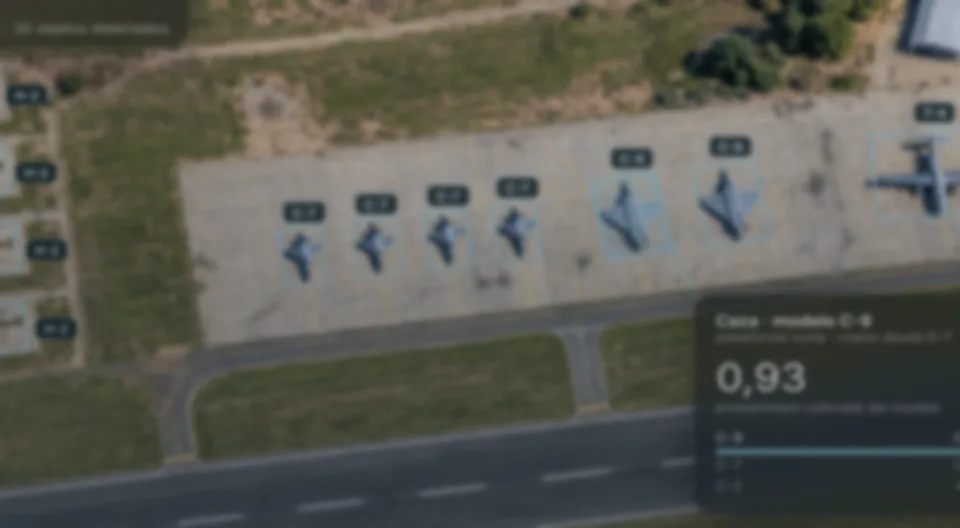
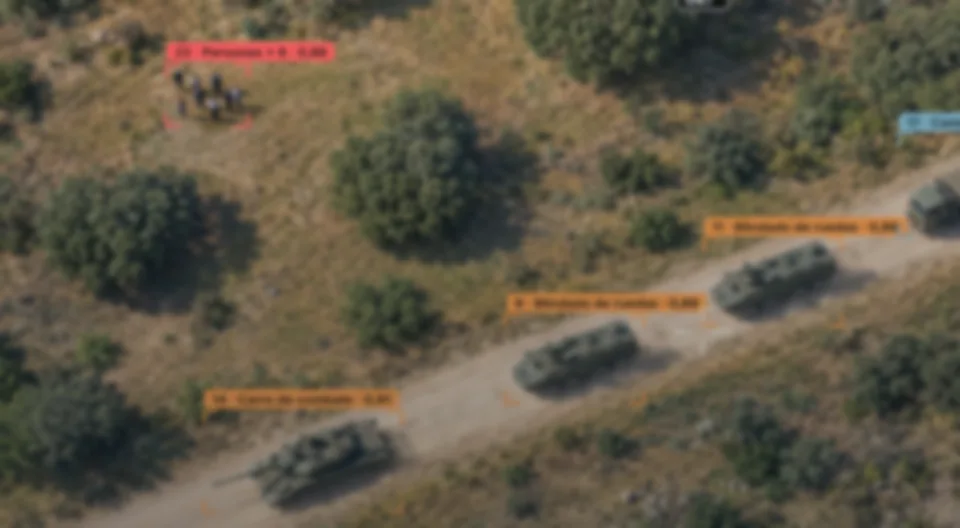
Atria's geospatial vision module: detects aircraft, vehicles and vessels by model, tracks mass movements and searches for objects, buildings and streets.
For: Intelligence and defence
4 sources: optical, SAR, aircraft and droneAtria module
Atria's on-board module for the drone: it detects without a link, coordinates swarms over a mesh network and sends the detections to Atria. The manufacturer integrates the software into its drone.
For: Drone manufacturers, agencies and critical infrastructure
< 20 ms per frame, target
Contact
Tell us what data you need to protect.
Atalaya support
Support for Atalaya, 24 hours a day.
Demo
We'll show you Atalaya with fictitious data.



Request a demo of Atria
Harpe runs it on data from its simulator and its lab, at your premises.